ASEAN's Crisis of Effectiveness in Handling Intra-Regional Conflicts Thailand and Cambodia
Article Sidebar
Main Article Content
Abstract
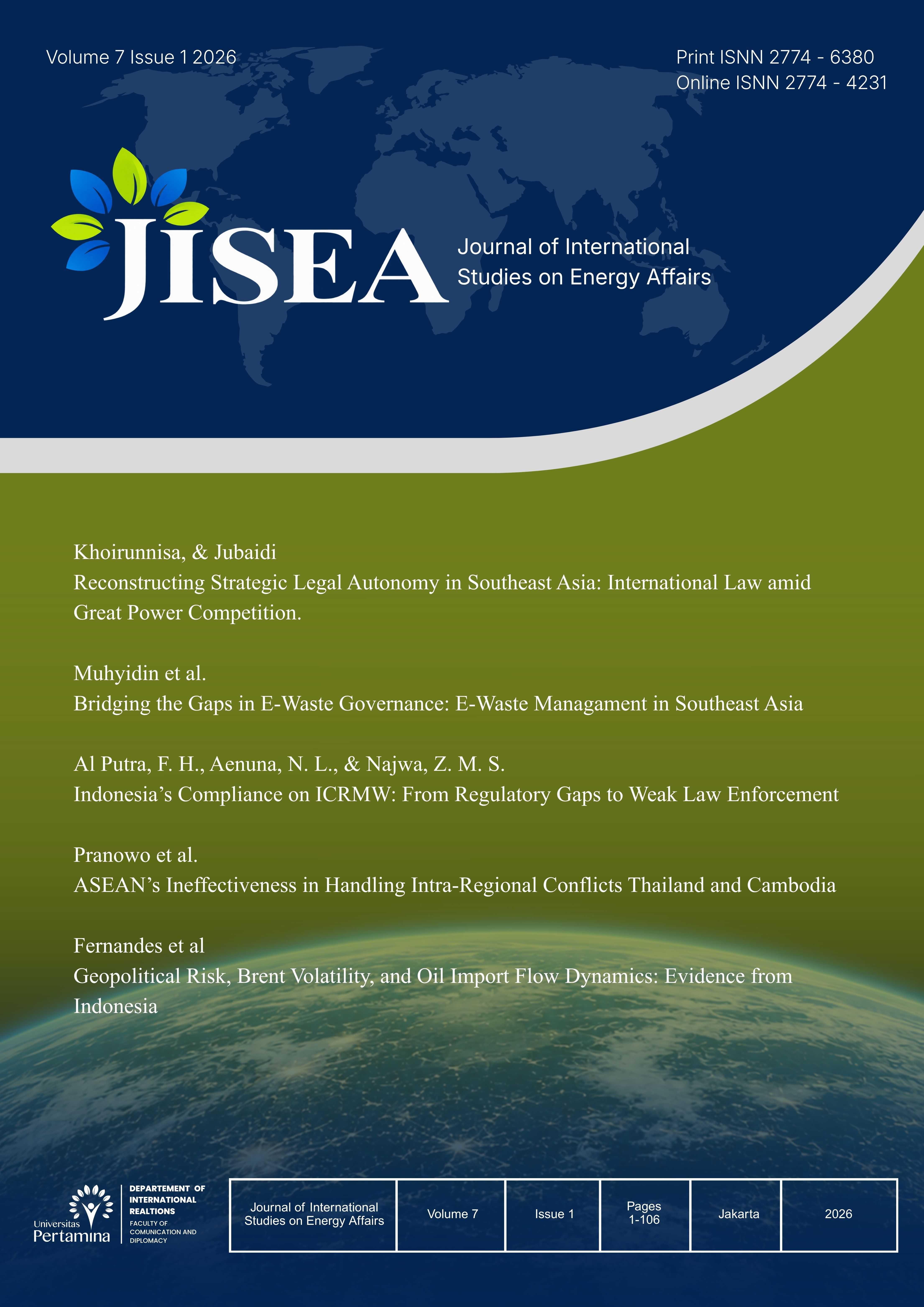
The war between Thailand and Cambodia that led to bloodshed in 2025 has repeatedly evaluated the role of ASEAN (Association of Southeast Asian Nations) as a multiregional organisation oriented towards peace and collective stability. The current escalation involves armed clashes, border closures, and the severance of economic cooperation between states, which is strongly correlated with historical events, which is a difference in interpretation regarding the 1907 French colonial map. These tensions highlight the failure of ASEAN’s Non-Interference Principle that considers the sovereignty of each member state. Its ineffectiveness is caused by its limitations in forming firm and concrete policies, resulting in insignificant impacts on conflict resolution. The strong urge of regionalism in achieving Positive Peace emphasizes peace as a collective ownership of a regional community in order to achieve long-term stability. ASEAN tends to approach peace through its normative values. However, as what shows on the Thailand and Cambodia conflict, the implementation which reveals failures and challenges in achieving balanced peace. In this contemporary era, the application of the Positive Peace concept provides a precise challenge for regionalism in maintaining peace and cooperation between states that tend to prioritize domestic urgencies.
Article Details
References
Farida, E. (2014). Penyelesaian Sengketa Perbatasan Antara Thailand Dan Kamboja Melalui Mekanisme Asean. Masalah-Masalah Hukum, 43(1), 57-66. https://doi.org/10.14710/mmh.43.1.2014.57-66
Hafizh, S. B., & Wiswayana, W. M. (2025). Kompleksitas konflik Thailand–Kamboja atas Kuil Preah Vihear: Peran ASEAN dalam stabilitas kawasan. MERDEKA: Jurnal Ilmiah Multidisiplin, 3(1), 306–311. https://doi.org/10.62017/merdeka.v3i1.6034
Naqsabandiyah, A. H. (2025, July 11). Revisiting ASEAN as Security Community: The Case of Thailand-Cambodia Longstanding Dispute – Institute for Global and Strategic Studies (IGSS). Uii.ac.id. https://igss.uii.ac.id/revisiting-asean-as-security-community-the-case-of-thailand-cambodia-longstanding-dispute/
Nisa, I. Y. (2016). Peran ASEAN dalam upaya penyelesaian konflik Kuil Preah Vihear antara Thailand dan Kamboja [S1 thesis, Universitas Muhammadiyah Yogyakarta]. ETD UMY Repository. https://etd.umy.ac.id/id/eprint/25919/
Pottu, O., & Siahaan, C. (2021). PERAN ASEAN DALAM PENYELESAIAN SENGKETA KUIL PREAH VIHEAR. JURNAL EKONOMI, SOSIAL & HUMANIORA,. https://www.jurnalintelektiva.com/index.php/jurnal/article/view/636
Raharjo, S. N. I. (2013). Tantangan konflik perbatasan Thailand–Kamboja bagi stabilitas ASEAN. https://download.garuda.kemdikbud.go.id/article.php?article=775539&val=12670&title=Tantangan%20Konflik%20Perbatasan%20Thailand-Kamboja%20Bagi%20Stabilitas%20ASEAN
Ramli, M. F., & Idris, H. (2022). Liberal Institutionalism Theory Approach in Asean’s Security Cooperation through Regionalism. Akademika, 92(1). https://doi.org/10.17576/akad-2022-9201-06
Ratcliffe, R. (2025, July 25). Thailand-Cambodia dispute: 130,000 Thai civilians evacuated amid second day of clashes. The Guardian; The Guardian. https://www.theguardian.com/world/2025/jul/25/thailand-cambodia-border-dispute-thai-e vacuation-clashes-conflict
Setyowati, H., & Nurulita, A. (2023). The Role of ASEAN in Dispute Resolution between Thailand and Cambodia. International Law Discourse in Southeast Asia, 2(1), 149–170. https://doi.org/10.15294/ildisea.v2i1.66152
Sumbodo, Y. P., Marzuki, M., Yudhantara, S. M., & Widiastuti, W. (2024). Metode penelitian. Media Penerbit Indonesia, 1(1), 63. http://repository.mediapenerbitindonesia.com/433/1/%28%2BISBN%29K%20205%20-%20Metode%20Penelitian.pdf
Tan, S. S. (n.d.). Not Quite Beyond the “ASEAN Way”? Southeast Asia’s Evolution to Rules-based Management of Intra-ASEAN Differences.
Tarigan, M. R. H. (2025). Relevance of the ASEAN Way amid global dynamics [Artikel ilmiah]. BEM UNAIR. https://bemunair.id/storage/karya-ilmiah/RxH5YCCqi1ryeSSmqLoKNy3OTimhWgmCvzSHMZfL.pdf
Tekunan, Susy. “The Asean Way: The Way to Regional Peace?” Jurnal Hubungan Internasional, vol. 3, no. 2, 2014, pp. 142–147, https://doi.org/10.18196/hi.2014.0056.142-147.
Tjandra, W. (2016). Perkembangan komunitas keamanan ASEAN dalam konflik Thailand–Kamboja. Jurnal International & Diplomacy Universitas Satya Negara Indonesia, 2(1), 1–18. https://jurnalhiusni.org/index.php/idu/article/view/109
Ulya, F. U. (2021). Analisis keterlibatan ASEAN dalam konflik Kamboja–Thailand melalui perspektif neoliberalisme [Artikel ilmiah]. ResearchGate. https://www.researchgate.net/publication/352799761_Analisis_Keterlibatan_ASEAN_dalam_Konflik_Kamboja-Thailand_melalui_Perspektif_Neoliberalisme